
Close Menu
    Facebook X (Twitter) Instagram
    Trending
    • Workplace Ninja User Group Denmark – April 2026 Meetup
    • Workplace Ninja User Group Denmark March 2026 Meetup
    • Workplace Ninja User Group Denmark February 2026 Meetup
    • Successful Adoption of a “Cloud First” Strategy
    • Speaking at Nordic Virtual Summit
    • Workplace Ninja User Group Denmark February Meetup
    • Workplace Ninja User Group Denmark Meetup – May 2022
    • Workplace Ninja User Group Denmark Meetup – April 2022
    RONNIPEDERSEN.COM
    • Home
    • Enterprise Mobility
      • Configuration Manager
      • Identity and Access
      • Information Protection
      • Intune
    • Cloud and Data Center
      • Data Center Management
      • Group Policy
      • Enterprise Security
      • Hyper-V
      • PowerShell
    • Guides
    • Webcasts
    • Links
    • About
      • Contact me
      • Disclaimer
    RONNIPEDERSEN.COM
    You are at:Home»Enterprise Mobility»Integrate Jamf Pro with Microsoft Intune

    Integrate Jamf Pro with Microsoft Intune

    0
    By Ronni Pedersen on June 8, 2019 Enterprise Mobility, Intune

    If an organization uses Jamf Pro to manage Mac computers, they can use Microsoft Intune compliance policies with Azure Active Directory conditional access to ensure that devices in your organization are compliant. This blogpost will explain how to setup the basic configuration if you need to integrate Jamf Pro with Microsoft Intune.

    To connect Microsoft Intune with Jamf Pro we need to complete the following 3 steps:

    1. Create a new application in Azure AD
    2. Enable Intune to integrate with Jamf Pro
    3. Configure Conditional Access in Jamf Pro

    Step 1: Create an application in Azure Active Directory

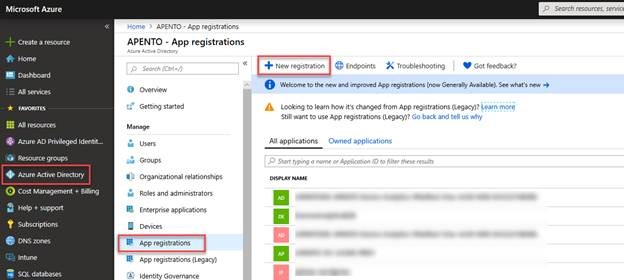
    In the Azure Portal, navigate to Azure Active Directory > App Registrations, and select New registration.
    clip_image002

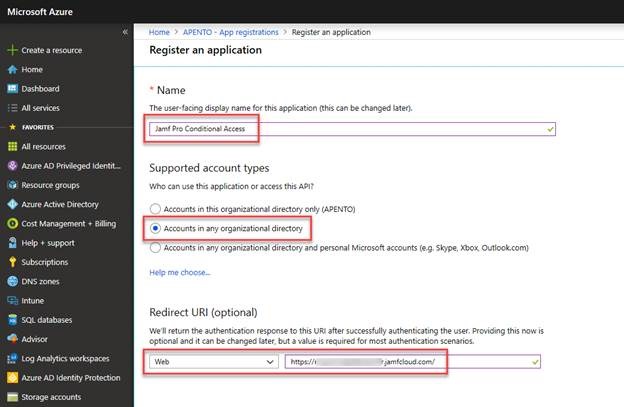
    On the Register an application page, specify the following details:

    • In the Name section, enter a meaningful application name (Jamf Conditional Access).
    • For the Supported account types section, select Accounts in any organizational directory.
    • For Redirect URI, leave the default of Web, and then specify the URL for your Jamf Pro instance.

    Click Register to create the application.
    clip_image004

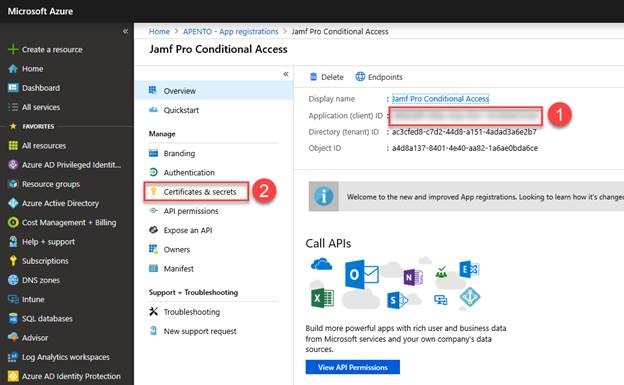
    On the app Overview page, copy the Application (client) ID value and save it for later use.
    clip_image006

    Select Certificates & secrets under Manage.

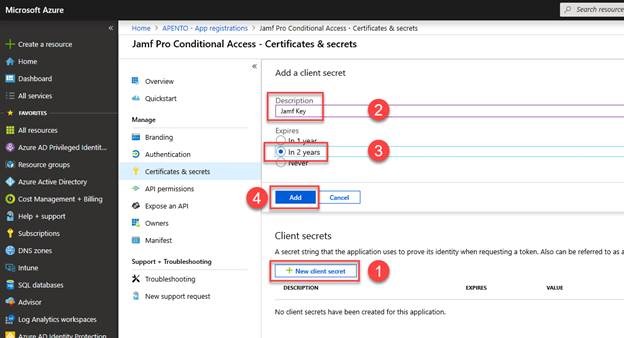
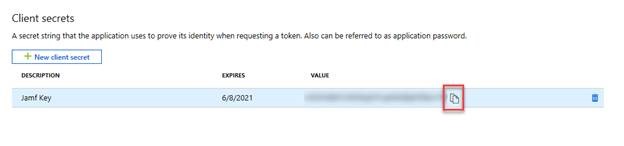
    Select the New client secret button. Enter a value in Description, select any option for Expires (I normally recommend 2 years) and click Add.
    clip_image008

    Important: Before you leave this page, copy the value for the client secret and record it for later use. You will need this value in later procedures. This value isn’t available again, without recreating the app registration.
    clip_image010

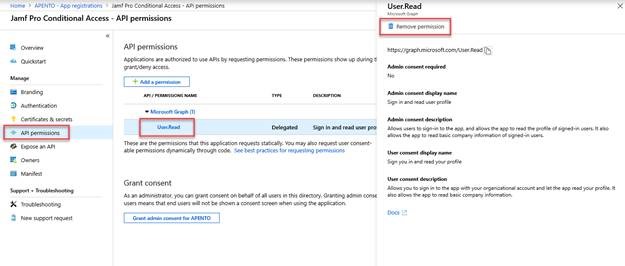
    Select API permissions under Manage. Select the existing permissions and then select Remove permission to delete those permissions.

    Note: Removal of all existing permissions is necessary as you’ll add a new permission, and the application only works if it has the single required permission.
    clip_image012

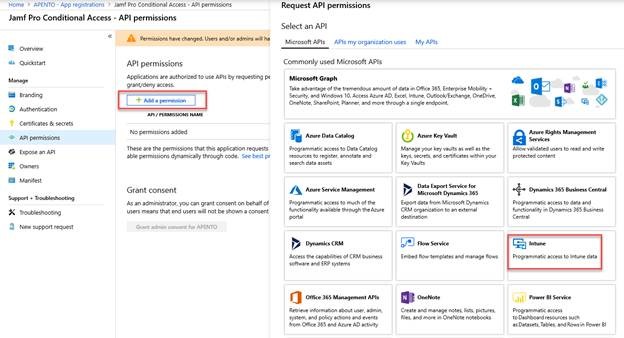
    To assign a new permission, select Add a permission. On the Request API permissions page, select Intune.
    clip_image014

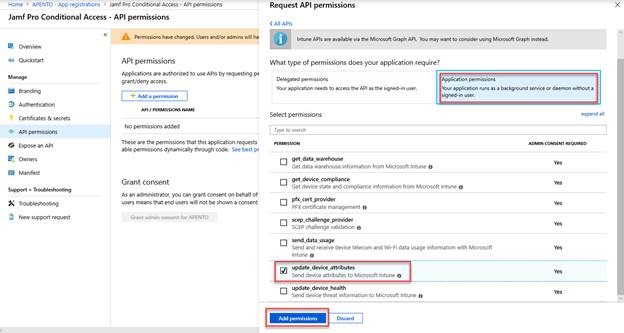
    Select Application permissions and select update_device_attributes.

    Select Add permission to save this configuration.
    clip_image016

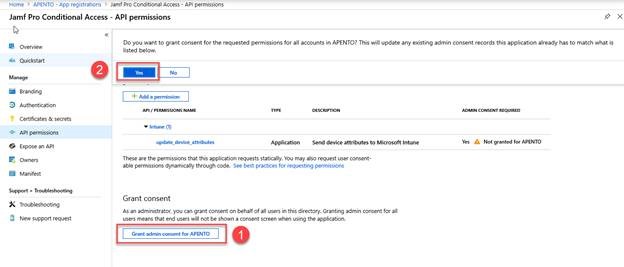
    On the API permissions page, select Grant admin consent for APENTO (Org Name) and then select Yes.
    clip_image018

    The app registration process in Azure AD is complete.

    Step 2: Enable Intune to integrate with Jamf Pro

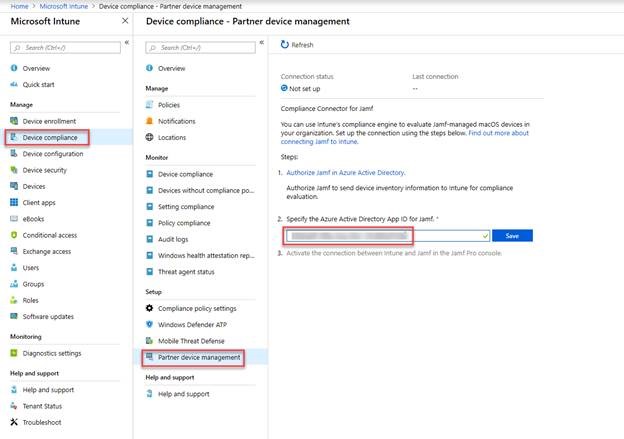
    Sign in to Intune, and navigate to Microsoft Intune > Device Compliance > Partner device management.

    Enable the Compliance Connector for Jamf by pasting the Application ID you saved during the previous procedure into the Jamf Azure Active Directory App ID field.

    Select Save.
    clip_image020

    Step 3: Configure Microsoft Intune Integration in Jamf Pro

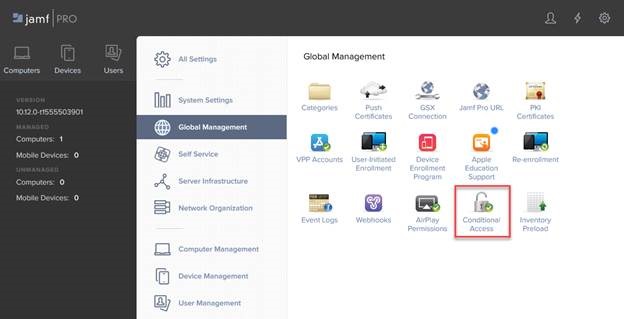
    In Jamf Pro, navigate to Global Management > Conditional Access. Click Edit on the Microsoft Intune Integration tab.
    clip_image022

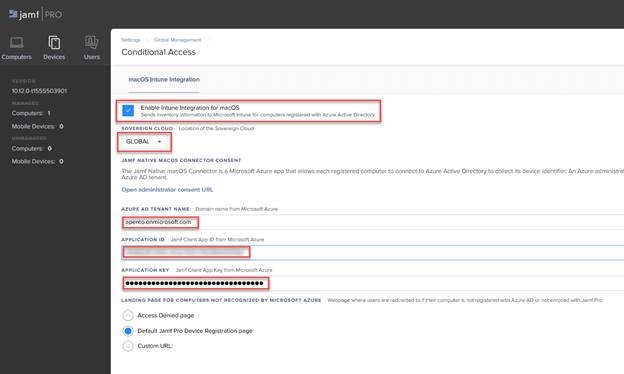
    Select Enable Intune Integration for macOS.

    Provide the required information about your Azure AD tenant:

    • Azure AD Tenant Name
    • Application ID
    • Application Key (the value for the client secret that you saved earlier in this guide)

    Select Save.
    clip_image024

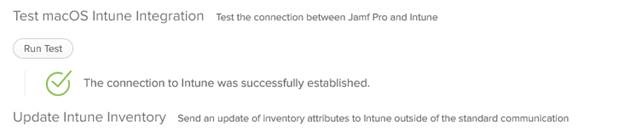
    Click Run Test to verity your settings.
    clip_image026

    That’s it… This completes the first step of the Jamf Pro integration with Azure AD and Microsoft Intune.

    /Enjoy

    • Tweet
    • Share 0
    • +1
    • LinkedIn 0

    Related

    Ronni Pedersen
    • Website
    • Facebook
    • X (Twitter)
    • LinkedIn

    My name is Ronni Pedersen and I'm currently working as a Cloud Architect at APENTO in Denmark. My primary focus is Enterprise Client Management solutions, based on technologies like AzureAD, Intune, EMS and System Center Configuration Manager. I'm is also a Microsoft Certified Trainer and Microsoft MVP in Enterprise Mobility.

    Related Posts

    Workplace Ninja User Group Denmark – April 2026 Meetup

    Workplace Ninja User Group Denmark March 2026 Meetup

    Workplace Ninja User Group Denmark February 2026 Meetup

    Leave A Reply Cancel Reply

    This site uses Akismet to reduce spam. Learn how your comment data is processed.

    Follow
    APENTO

    Follow APENTO here:

    Subscribe to Blog via Email

    Enter your email address to subscribe to this blog and receive notifications of new posts by email.

    About
    My name i s Ronni Pedersen and I'm currently working as a Cloud Architect at APENTO in Denmark. My primary focus is Endpoint Management and Security, based on Microsoft technologies. I'm also a Microsoft Certified Trainer and a dual Microsoft MVP in both Security and Windows.
    Recent Posts
    • Workplace Ninja User Group Denmark – April 2026 Meetup
    • Workplace Ninja User Group Denmark March 2026 Meetup
    • Workplace Ninja User Group Denmark February 2026 Meetup
    • Successful Adoption of a “Cloud First” Strategy
    • Speaking at Nordic Virtual Summit
    Archives
    TOP POSTS
    • Post-CU3 update is available for SCCM 2012 SP1
    • Enable the Debug Shell on your ConfigMgr boot image
    • Links from MS-10747D Class
    • Software Update for ConfigMgr 2007 SP2 Setup Wizard ended prematurely
    • Importing drivers for OSD in ConfigMgr 2012
    RECENT COMMENTS
    • cOSHi on Missing “UserType” attribute in Azure AD
    • Gus on Pro Tip: Use Ctrl+Alt+D from the Azure Portal to get performance information
    • Sebi on Prepare for Co-Management: Migrate Intune Devices without user affinity
    • Vadim P on SCCM: Failed to Get Client Identity (80004005)
    • TM on Active Directory Based Activation in an multi domain environment
    DISCLAIMER
    The content on this website is presented "as-is" with no guarantees. The use of scripts from this website is at your own risk. Always test before putting something in production! Opinions expressed are my own.
    © 2026 ThemeSphere. Designed by ThemeSphere.

    Type above and press Enter to search. Press Esc to cancel.