
Close Menu
    Facebook X (Twitter) Instagram
    Trending
    • Workplace Ninja User Group Denmark – April 2026 Meetup
    • Workplace Ninja User Group Denmark March 2026 Meetup
    • Workplace Ninja User Group Denmark February 2026 Meetup
    • Successful Adoption of a “Cloud First” Strategy
    • Speaking at Nordic Virtual Summit
    • Workplace Ninja User Group Denmark February Meetup
    • Workplace Ninja User Group Denmark Meetup – May 2022
    • Workplace Ninja User Group Denmark Meetup – April 2022
    RONNIPEDERSEN.COM
    • Home
    • Enterprise Mobility
      • Configuration Manager
      • Identity and Access
      • Information Protection
      • Intune
    • Cloud and Data Center
      • Data Center Management
      • Group Policy
      • Enterprise Security
      • Hyper-V
      • PowerShell
    • Guides
    • Webcasts
    • Links
    • About
      • Contact me
      • Disclaimer
    RONNIPEDERSEN.COM
    You are at:Home»Enterprise Mobility»Configuration Manager»Find the TimeZoneName for your SCCM/MDT Deployments

    Find the TimeZoneName for your SCCM/MDT Deployments

    0
    By Ronni Pedersen on August 14, 2017 Configuration Manager, Enterprise Mobility, Windows Deployment

    Today I got a call from a customer that was playing around with OSD in System Center Configuration Manager and the Microsoft Deployment Toolkit (MDT). He wanted to know where he could find a list of all the Time Zones Names, so he could change the default “Pacific Standard Time” to something else. But where can you find a list of all the “TimeZoneName”?

    Instead of using some old reference list on TechNet or MSDN, you can simply use the good old Time Zone Utility (Tzutil), that can be used to view and manage available time zones.

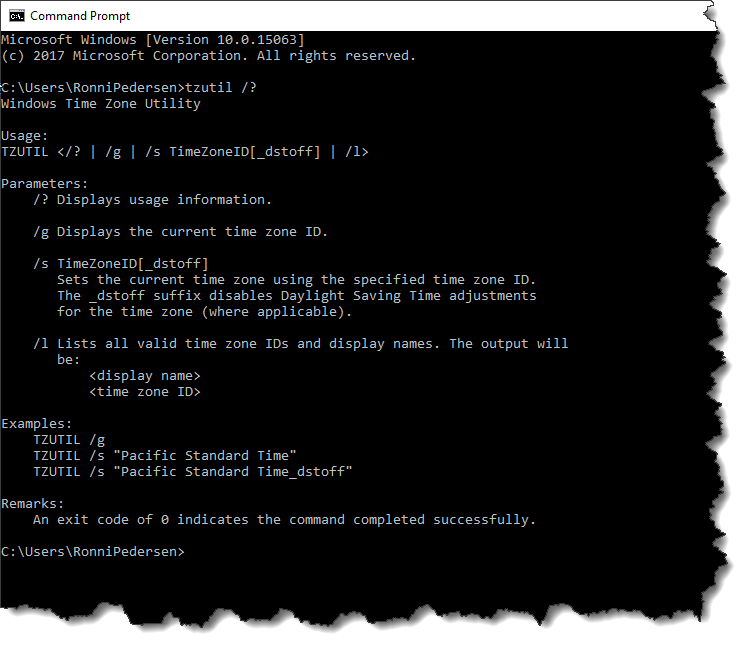
    You can run Tzutil from a command prompt, to get a list of all the options:
    SNAGHTML19748426

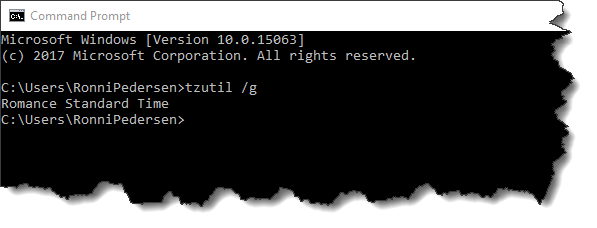
    The following example displays the current time zone.
    tzutil /g
    SNAGHTML1976b6f4

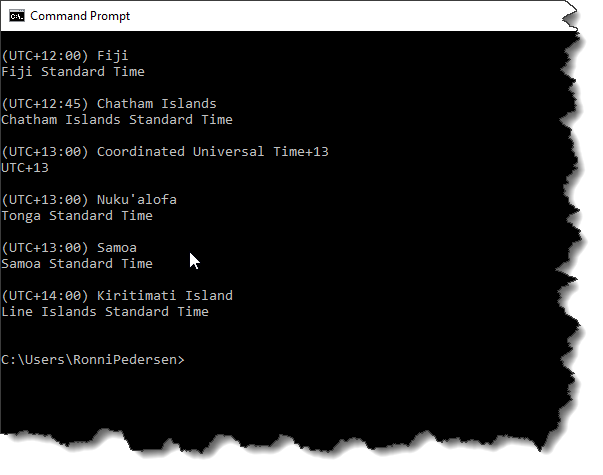
    The following example lists all available time zones.
    tzutil /l
    SNAGHTML19770003

    Tzutil Command-Line Reference:
    https://technet.microsoft.com/library/hh825053.aspx

    That’s it… Enjoy!

    +Ronni Pedersen

    • Tweet
    • Share 0
    • +1
    • LinkedIn 0

    Related

    Ronni Pedersen
    • Website
    • Facebook
    • X (Twitter)
    • LinkedIn

    My name is Ronni Pedersen and I'm currently working as a Cloud Architect at APENTO in Denmark. My primary focus is Enterprise Client Management solutions, based on technologies like AzureAD, Intune, EMS and System Center Configuration Manager. I'm is also a Microsoft Certified Trainer and Microsoft MVP in Enterprise Mobility.

    Related Posts

    Speaking at Nordic Virtual Summit

    Workplace Ninja User Group Denmark February Meetup

    Speaking at Modern Endpoint Management Summit 2022

    Leave A Reply Cancel Reply

    This site uses Akismet to reduce spam. Learn how your comment data is processed.

    Follow
    APENTO

    Follow APENTO here:

    Subscribe to Blog via Email

    Enter your email address to subscribe to this blog and receive notifications of new posts by email.

    About
    My name i s Ronni Pedersen and I'm currently working as a Cloud Architect at APENTO in Denmark. My primary focus is Endpoint Management and Security, based on Microsoft technologies. I'm also a Microsoft Certified Trainer and a dual Microsoft MVP in both Security and Windows.
    Recent Posts
    • Workplace Ninja User Group Denmark – April 2026 Meetup
    • Workplace Ninja User Group Denmark March 2026 Meetup
    • Workplace Ninja User Group Denmark February 2026 Meetup
    • Successful Adoption of a “Cloud First” Strategy
    • Speaking at Nordic Virtual Summit
    Archives
    TOP POSTS
    • SCCM 2012 R2: Where is the SMSTS.log located?
    • Missing “UserType” attribute in Azure AD
    • Find the TimeZoneName for your SCCM/MDT Deployments
    • Windows Vista Pre-Build VHD available for download
    • HOW-TO: Sequence applications using App-V 5 for SCCM 2012
    RECENT COMMENTS
    • cOSHi on Missing “UserType” attribute in Azure AD
    • Gus on Pro Tip: Use Ctrl+Alt+D from the Azure Portal to get performance information
    • Sebi on Prepare for Co-Management: Migrate Intune Devices without user affinity
    • Vadim P on SCCM: Failed to Get Client Identity (80004005)
    • TM on Active Directory Based Activation in an multi domain environment
    DISCLAIMER
    The content on this website is presented "as-is" with no guarantees. The use of scripts from this website is at your own risk. Always test before putting something in production! Opinions expressed are my own.
    © 2026 ThemeSphere. Designed by ThemeSphere.

    Type above and press Enter to search. Press Esc to cancel.