Close Menu
    Facebook X (Twitter) Instagram
    Trending
    • Workplace Ninja User Group Denmark – April 2026 Meetup
    • Workplace Ninja User Group Denmark March 2026 Meetup
    • Workplace Ninja User Group Denmark February 2026 Meetup
    • Successful Adoption of a “Cloud First” Strategy
    • Speaking at Nordic Virtual Summit
    • Workplace Ninja User Group Denmark February Meetup
    • Workplace Ninja User Group Denmark Meetup – May 2022
    • Workplace Ninja User Group Denmark Meetup – April 2022
    RONNIPEDERSEN.COM
    • Home
    • Enterprise Mobility
      • Configuration Manager
      • Identity and Access
      • Information Protection
      • Intune
    • Cloud and Data Center
      • Data Center Management
      • Group Policy
      • Enterprise Security
      • Hyper-V
      • PowerShell
    • Guides
    • Webcasts
    • Links
    • About
      • Contact me
      • Disclaimer
    RONNIPEDERSEN.COM
    You are at:Home»Uncategorized»SCCM 2012: Requirement Rules for Microsoft Office 32 or 64 bit

    SCCM 2012: Requirement Rules for Microsoft Office 32 or 64 bit

    4
    By Ronni Pedersen on November 8, 2012 Uncategorized

    System Center 2012 Configuration Manager has many great built-in requirement rules that will help you to get the right deployment type installed for the current environment.

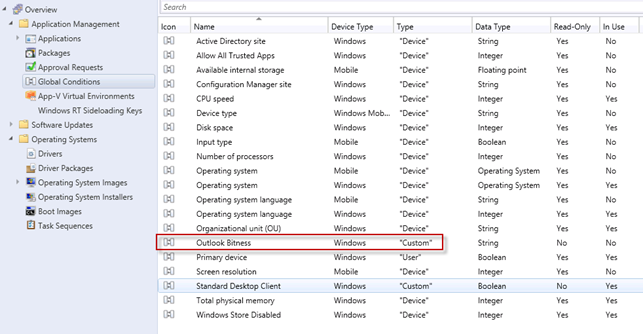
    For most of my applications the built-in rules can get the job done, but some times we need to create our own Global Conditions, to fit the requirement rules for an application/Deployment Type.

    One example could be a 3rd. party add-on for Microsoft Office, where you need to install a Deployment Type that matches the architecture of Microsoft Office.

    All clients with a 32-bit OS will always have the 32-bit version of Office installed, but users with the 64-bit version of the OS, can use both the 32-bit or the 64-bit version of office installed (and most users do run 32-bit).

    Then we need to create a Global Condition that will detect the architecture of Microsoft Office.

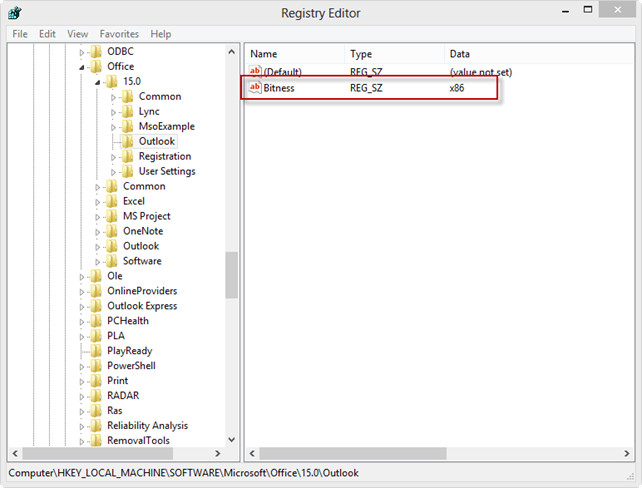
    In Microsoft Office 2013, you will see the following registry key, that will help you to detect this

    HKEY_LOCAL_MACHINE\SOFTWARE\Microsoft\Office\15.0\Outlook
    clip_image002

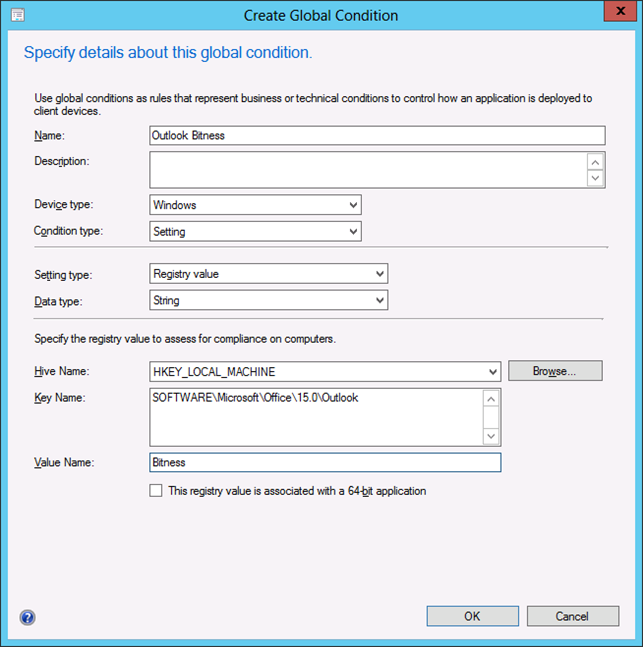
    So all we need to do, is to create a new Global Condition with the following settings:

    Name: Outlook Bitness
    Device Type: Windows
    Condition type: Setting

    Setting type: Registry value
    Data type: String

    Hive: HKEY_LOCAL_MACHINE
    Key: SOFTWARE\Microsoft\Office\15.0\Outlook
    Value: Bitness
    image

    image

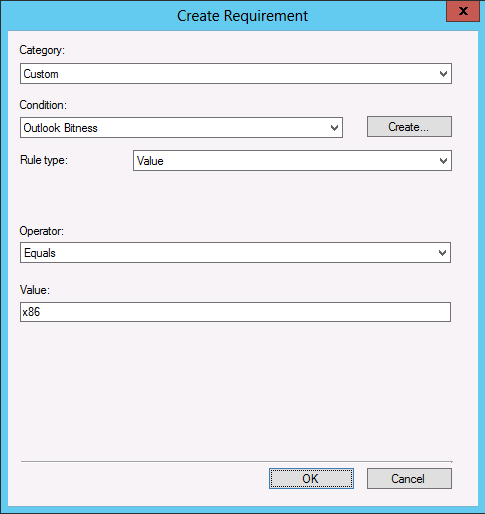
    Now we can create a custom requirement rule for the application.
    image

    Enjoy

    +Ronni Pedersen

    • Tweet
    • Share 0
    • +1
    • LinkedIn 0

    Related

    Ronni Pedersen
    • Website
    • Facebook
    • X (Twitter)
    • LinkedIn

    My name is Ronni Pedersen and I'm currently working as a Cloud Architect at APENTO in Denmark. My primary focus is Enterprise Client Management solutions, based on technologies like AzureAD, Intune, EMS and System Center Configuration Manager. I'm is also a Microsoft Certified Trainer and Microsoft MVP in Enterprise Mobility.

    Related Posts

    Successful Adoption of a “Cloud First” Strategy

    Workplace Ninja User Group Denmark Meetup – May 2022

    Managing Extended Security Updates for Windows 7 using Microsoft Endpoint Manager

    4 Comments

    1. Pingback: How to Setup Requirment Rules for Outlook 32 bit or 64 bit - Rui Qiu's Blog

    2. Jim on November 16, 2016 22:31

      This almost does what I need, but I have multiple versions of Office in our environment. Is there a way to detect bit version that is not dependent on the Office software version?

      Reply
      • Bruce Sa on February 5, 2020 06:34

        – Computer\HKEY_LOCAL_MACHINE\SOFTWARE\Microsoft\Office\ClickToRun\Configuration
        – Platform = x..

        Also check the box “This registry value is associated with a 64bit application”

        Reply
        • Chriswillo on January 8, 2021 12:13

          Thank You ! Very helpful and Bruce saved me a load of time digging around the registry for the query solution for “multiple versions of office” 🙂

          Reply
    Leave A Reply Cancel Reply

    This site uses Akismet to reduce spam. Learn how your comment data is processed.

    Follow
    APENTO

    Follow APENTO here:

    Subscribe to Blog via Email

    Enter your email address to subscribe to this blog and receive notifications of new posts by email.

    About
    My name i s Ronni Pedersen and I'm currently working as a Cloud Architect at APENTO in Denmark. My primary focus is Endpoint Management and Security, based on Microsoft technologies. I'm also a Microsoft Certified Trainer and a dual Microsoft MVP in both Security and Windows.
    Recent Posts
    • Workplace Ninja User Group Denmark – April 2026 Meetup
    • Workplace Ninja User Group Denmark March 2026 Meetup
    • Workplace Ninja User Group Denmark February 2026 Meetup
    • Successful Adoption of a “Cloud First” Strategy
    • Speaking at Nordic Virtual Summit
    Archives
    TOP POSTS
    • SCCM 2012: How does Automatic Client Upgrade work?
    • Installing SCCM 2012 SP2/R2 SP1 – Quick Start Guide
    • Microsoft Security Essentials available FREE to Small Businesses
    • Configuration Manager 2007 Service Pack 1 released
    • Microsoft Deployment Toolkit 2010 Update 1 vs. Modena
    RECENT COMMENTS
    • cOSHi on Missing “UserType” attribute in Azure AD
    • Gus on Pro Tip: Use Ctrl+Alt+D from the Azure Portal to get performance information
    • Sebi on Prepare for Co-Management: Migrate Intune Devices without user affinity
    • Vadim P on SCCM: Failed to Get Client Identity (80004005)
    • TM on Active Directory Based Activation in an multi domain environment
    DISCLAIMER
    The content on this website is presented "as-is" with no guarantees. The use of scripts from this website is at your own risk. Always test before putting something in production! Opinions expressed are my own.
    © 2026 ThemeSphere. Designed by ThemeSphere.

    Type above and press Enter to search. Press Esc to cancel.